Case Study
Operation System Design
Mapped the entire customer journey from sales to service and created a comprehensive software spec to unify quoting, installation, inventory, and invoicing into one streamlined system.
Role
Product Designer & Operations Consultant
Timeline
4 months
Tools
Figma, Miro, Google Sheets, Notion
Overview
A growing surveillance camera installation company was operating across a patchwork of disconnected tools for quoting, scheduling, inventory tracking, installation management, and invoicing. Sales, operations, and accounting each had their own workflows, leading to data silos, duplicated effort, and a fragmented customer experience. I was brought in to map the full customer lifecycle and design a unified software specification that would bring all operations under one roof.
Discovery & Process Mapping
I started by shadowing team members across every department, from the sales team running quotes to the field crews managing installations to the back office handling invoicing. Through interviews and observation, I mapped the complete customer journey, identifying every handoff, data entry point, and decision node.
The resulting process map revealed critical friction points: duplicate data entry across three separate systems, a lack of real-time inventory visibility for the sales team, and no unified view of a customer's status across the lifecycle.
Competitive & Feature Analysis
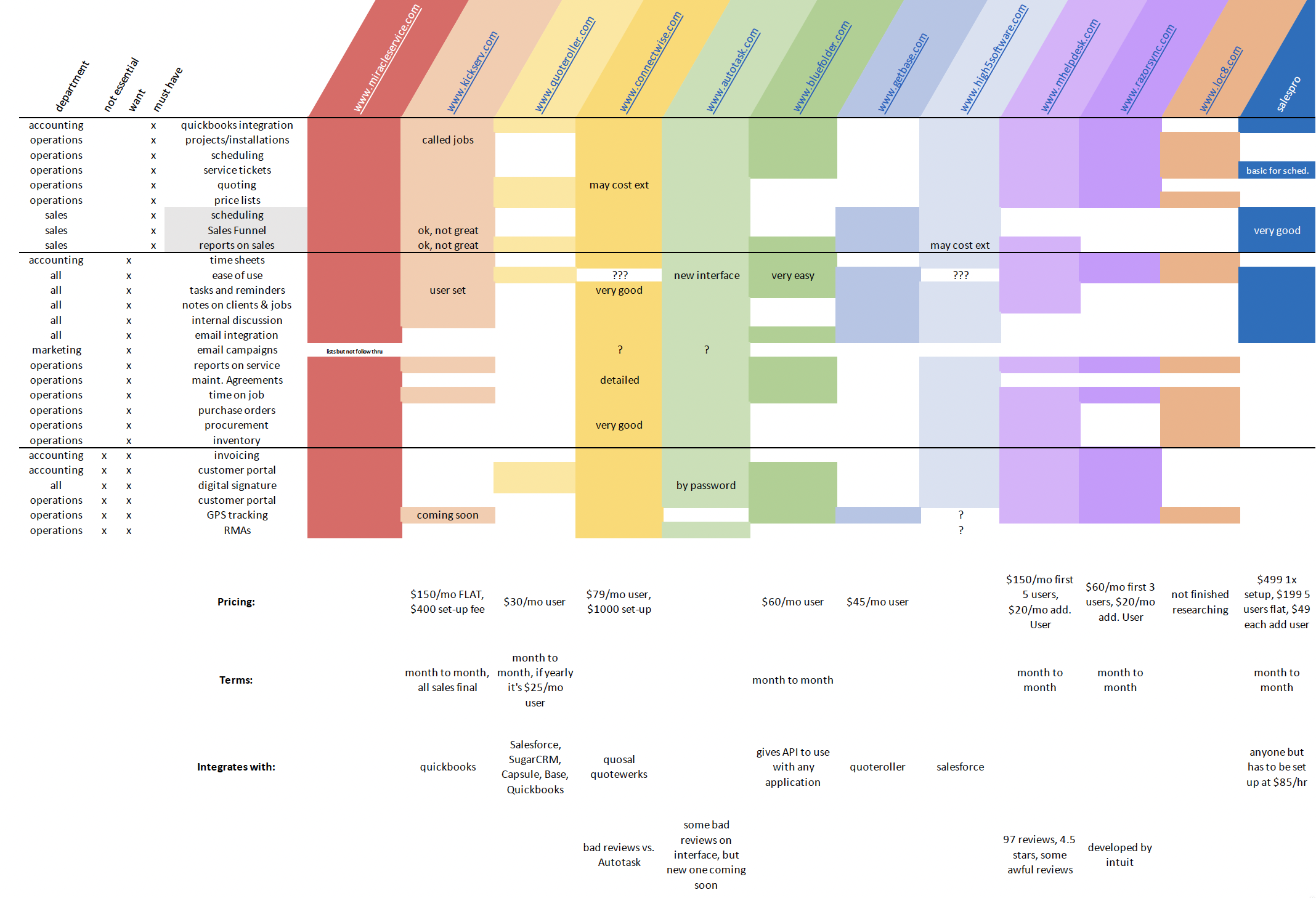
I evaluated 11 field service and CRM platforms against departmental requirements — from MiracleService and Kickserv to ConnectWise, Autotask, and mHelpDesk. For each vendor, I mapped must-haves (QuickBooks integration, scheduling, service tickets, quoting), wants (sales funnel, reports, maintenance agreements), and nice-to-haves (GPS tracking, RMAs, customer portals).
The resulting matrix revealed critical tradeoffs: ConnectWise offered depth but at $79/user/month with $1,000 setup; Kickserv was easier to use but lacked procurement features; Base CRM had excellent sales funnel tools but weak service ticket handling. This analysis informed the recommendation for a hybrid approach, combining best-of-breed tools with custom integration work.
System Specification
With the process map and competitive analysis in hand, I authored a comprehensive software specification document. This spec covered every module, from lead capture and quoting through scheduling, inventory management, installation tracking, and final invoicing.
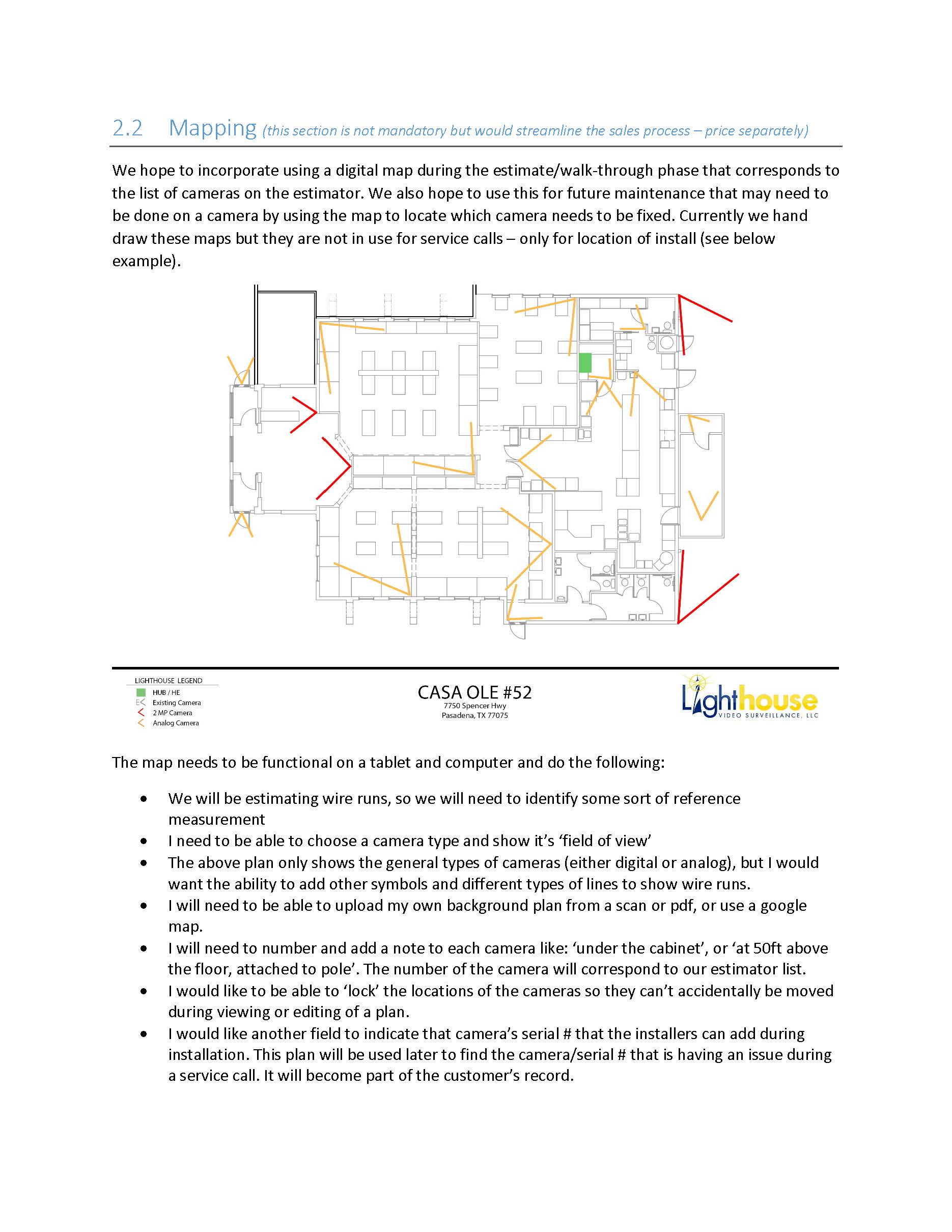
Each module included user stories, workflow diagrams, data models, and wireframes. A key innovation was the digital mapping feature, allowing field teams to upload floor plans, place camera icons with field-of-view cones, estimate wire runs, and lock positions during installation. The spec also defined integration points between modules, ensuring that data flowed seamlessly from one stage to the next without manual re-entry.
Stakeholder Alignment
I presented the spec to stakeholders across all departments, gathering feedback and iterating on the design. This collaborative process ensured buy-in from every team that would be affected by the new system, and surfaced edge cases and requirements that only emerged through cross-functional dialogue.
Outcome
The comprehensive specification became the blueprint for the company's digital transformation initiative. It unified five previously disconnected workflows into a single, coherent system design, with clear implementation phases and priorities. The document enabled the company to engage development partners with a precise, well-documented brief, significantly reducing scoping risk and accelerating the path to implementation.